

The short answer
Up to about 8–10″: axial push camera. From about 8″ to 20″ on shorter runs: pan-and-tilt head on a push cable. 8″ and up on long runs, mainlines, or when the report must show every joint: crawler. The bands overlap; inside the overlap, run length, access and what the report must show decide.
| Pipe diameter | Usual first choice | Why | Consider instead when… |
|---|---|---|---|
| 4–6″ | Axial push camera, self-leveling head | Head fills much of the pipe, light reaches the wall, rod pushes through bends | The report must show wall detail at each joint (pan-and-tilt) |
| 6–10″ | Axial push camera, or pan-and-tilt on push cable | Axial still works; image gets dimmer and the head rides on the invert as diameter grows | Runs are long or the line is a mainline (crawler) |
| 10–20″ | Pan-and-tilt head on push cable with a centering skid, or crawler | Needs aimable view and more light; push reach becomes the limit | Runs exceed what you can push, or you need zoom and measurements (crawler) |
| 12–24″ | Crawler with pan/tilt/zoom camera | Drives the distance, carries brighter lights, centers the camera, zooms on defects | You only need a quick screen from the manhole (zoom camera) |
Diameter ranges at a glance
The ranges below come from the current product pages of the three systems featured in this guide. They show how the classes overlap.
Where axial push cameras stop being the right tool
Above about 8–10″, a small forward-view head can't light the wall, can't stay centered and can't look at a joint straight on. It still travels, but the footage gets harder to read and easier to dispute.
- Light runs out. A 1″ head carries small LEDs sized for drain pipe. Asked whether the VIPER MID could inspect 12″ and 40″ pipe, our team's answer on its product page was direct: it "will not have enough light to illuminate 12" or 40" pipes."
- The head rides on the invert. In a large pipe the head lies on the bottom, so the crown is far away and the near wall is washed out. Centering skids help in 4–6″ pipe; the VIPER skid is listed for 4″ and 6″ lines.
- Forward view only. Cracks, offset joints and lateral connections are on the wall. A forward-view head sees them at a steep angle as it passes.
- Reach is limited by pushing. The longer the run, the stiffer the push rod must be; on the VIPER MID page we note that push cameras usually top out around 400 ft. Bends and friction cut that further.
Below the hand-off, axial push cameras are hard to beat: small, fast to deploy from a cleanout, able to negotiate bends, and simple enough for one person. For 2–6″ selection, see our sewer camera guide for 2–6 inch pipes.
Pan-and-tilt on a push cable: the bridge from 8″ to 20″
A pan-and-tilt head lets you stop, turn the camera to the wall and read each joint, without moving up to a crawler. It keeps the push-camera workflow (one operator, cleanout or manhole access, no tractor) while fixing the two weak points of an axial head in larger pipe: view direction and light.
- Aim: on the ANACONDA MID, the 2″ (50 mm) head pans 360° and tilts 160°.
- Light: adjustable white LEDs; turn them down on close, shiny surfaces and up in wide pipe.
- Centering: an expanding steel roller skid, listed for 8–24″ pipe, lifts the head off the invert so the wall is evenly lit.
- Reach: 196 ft (60 m) of 7 mm push cable. That covers many laterals, building drains, culverts and short storm runs, but not a long mainline between manholes.
When it's time for a crawler
Move to a crawler when the run is longer than you can push, the pipe is 12″ and up, or the report must show every joint in detail. A crawler drives itself down the pipe on a tether, so reach is set by the cable, not by pushing, and it carries a bigger camera and bigger lights.
| Pan-and-tilt push camera (ANACONDA MID) | Crawler (STORMER X) | |
|---|---|---|
| Listed pipe range | 2–20″ (roller skid for 8–24″) | 6–80″ (DN150–2000), wheel sets for 6″, 12″ and 16″ in the base set |
| Reach | 196 ft (60 m) push cable | 656 ft (200 m) cable standard, 984 ft (300 m) in the Advanced set; longer reels quoted up to 1,650 ft |
| Camera | Pan 360°, tilt 160°, 1.3 MP sensor, autofocus | Full HD pan and tilt, 10× optical / 12× digital zoom, autofocus |
| Lighting | Adjustable white LEDs | 2,160-lumen LED lighting, 0.1 lux sensitivity |
| Centering | Roller skid | Electric camera lift moves the head toward the pipe center line; extension wheel sets |
| Data | On-screen footage counter, recording | Distance sensor on the reel, inclination measurement, groundwater inflow sensor, IKAM inspection software; optional lasers for diameter, ovality and crack width |
| Crew and setup | One person, from a cleanout or manhole | Reel, crawler and tablet travel as one wheeled unit on two tool batteries; usually manhole access |
Crawlers also do better in cleaned lines: Envirosight notes that crawler inspections go more smoothly when pipes have been cleaned beforehand (Envirosight). Plan jetting before the camera on heavily loaded lines.
Run length, access and flow: the tie-breakers
Inside an overlap band, three job facts settle the choice:
- Run length. Measure manhole to manhole, or cleanout to the farthest point. If it's beyond the push cable you can handle, it's a crawler job, whatever the diameter.
- Access. A cleanout or small opening favors a push camera. Manhole access opens up crawlers and, for a quick look down a straight line, a manhole zoom camera.
- Flow and water level. Video shows only what is above the water line. Plan inspection for low flow, or bypass; for lines that can't be drained, a floating crawler is a separate class of tool.
Then ask what the footage is for. A diagnostic look for a blockage needs less than a condition assessment that a city, engineer or buyer will rely on.
Fiberscope equipment to consider
One system per class. Specifications are taken from the current product pages; tell us the diameters, run lengths and access points and we'll confirm the configuration.
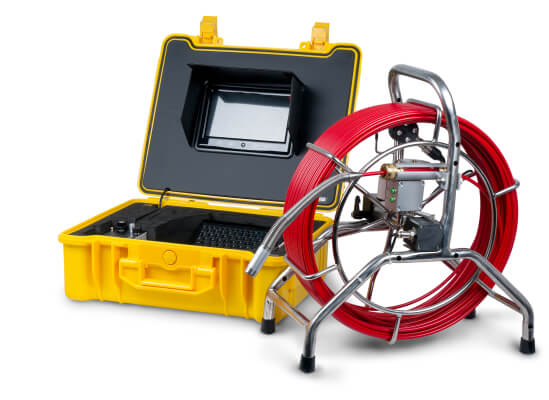
VIPER MID
Axial push camera for 2–8″ lines, laterals and ducts.
- 17 mm or 23 mm (1″) heads; straight, side-view or self-leveling
- Up to 196 ft push cable; 512 Hz sonde on the 1″ head
- 9″ monitor, AVI/JPEG recording, keyboard included
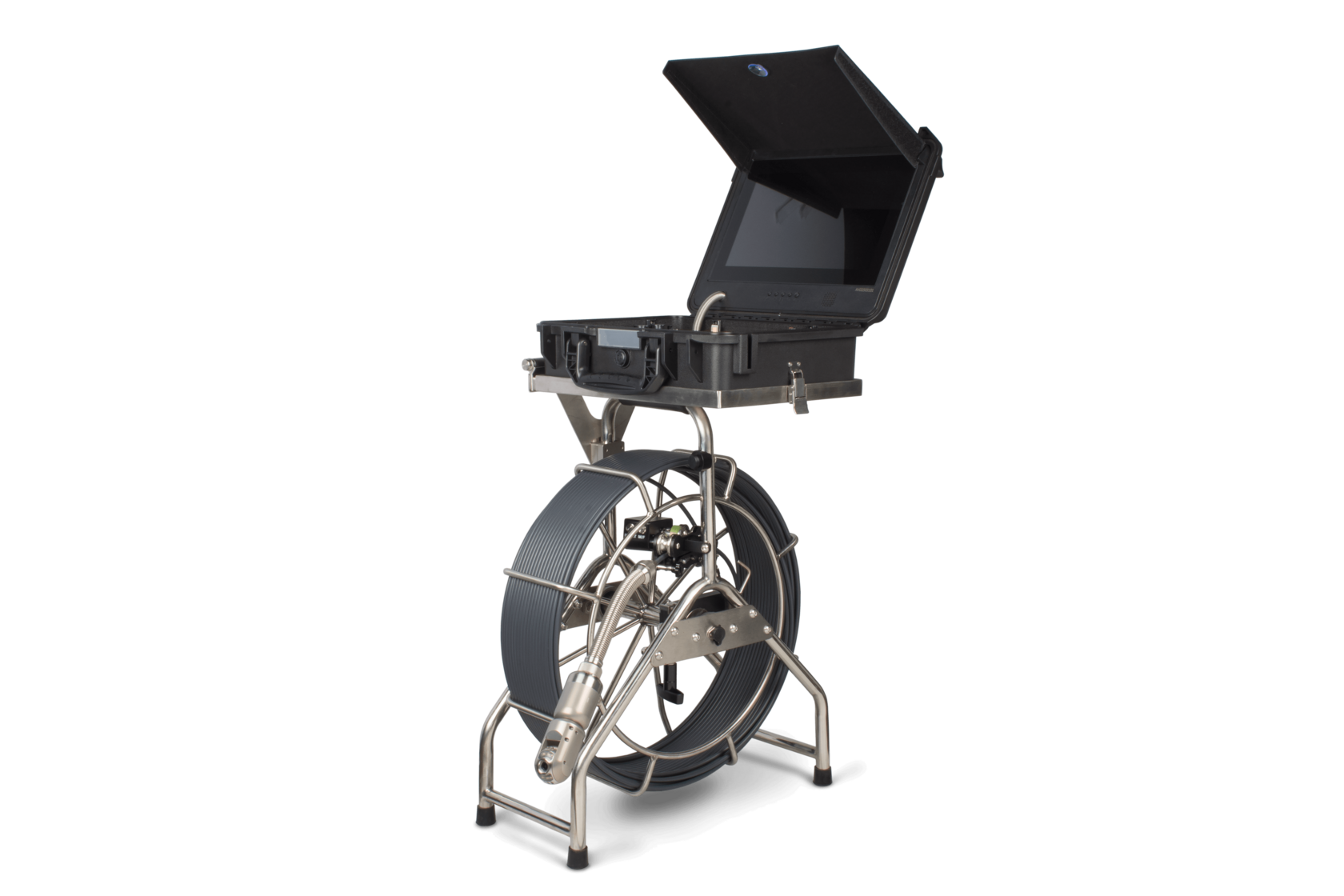
ANACONDA MID
Pan-and-tilt or self-leveling push camera for 2–20″ pipes.
- 2″ pan-and-tilt head (360° / 160°) or 1.57″ self-leveling head
- 196 ft (60 m) push cable; optional roller skid for 8–24″
- 1280×720 display; 512 Hz sonde in both heads
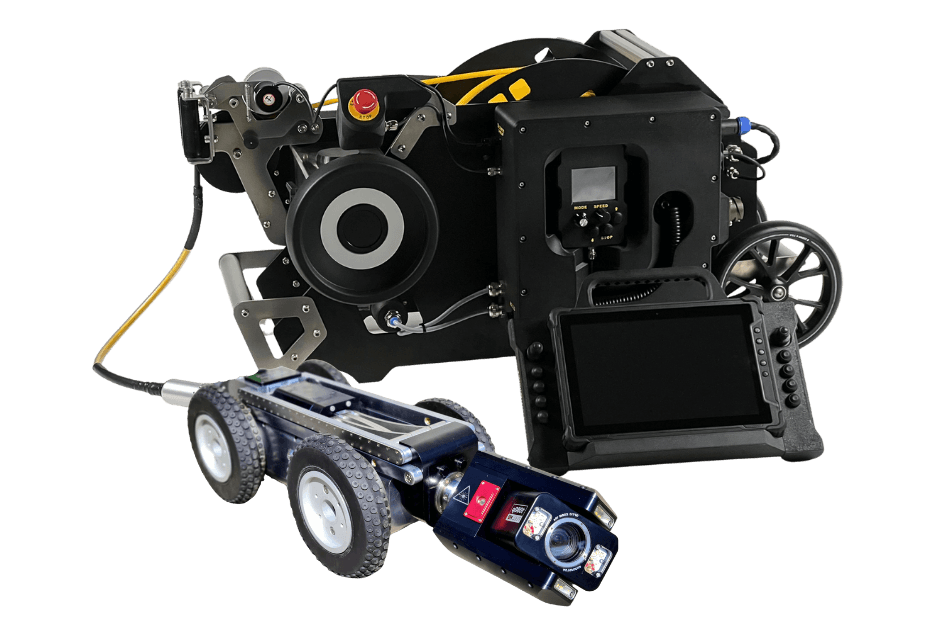
STORMER X
Municipal-grade crawler for 12″-and-up mainlines, storm lines and culverts.
- Full HD pan and tilt, 10× optical zoom, 2,160-lumen LEDs, electric camera lift
- 6–80″ pipe; 656 ft (200 m) cable standard, up to 984 ft in the Advanced set
- Runs on two tool batteries (e.g. DeWalt, Milwaukee); IKAM software; optional measuring lasers
For 4–16″ lines that need a smaller tractor, the STORMER S shares the same reel, tablet and software. See all push cameras and pipe inspection robots. For a quick screen from the manhole, see the CYCLOPS TZ manhole zoom camera. Need a system for one job? See the rental program.
Questions contractors and crews ask
What camera do I need for a 12-inch sewer main?
For short runs, a pan-and-tilt head on a push cable with a centering skid can work. For a mainline between manholes, or when the footage must document every joint, use a crawler with a pan/tilt/zoom camera. A small axial push camera usually lacks the light for 12-inch pipe.
Up to what diameter is a push camera a good choice?
In our field experience, an axial push camera is normally optimal up to about 8–10 inches. Above that, use a pan-and-tilt head with better lighting, or a crawler with a larger camera head.
How far can a push camera go?
It depends on the rod stiffness, bends and pipe condition. Push cameras usually top out around 400 feet; the systems in this guide carry 196 feet of push cable. Longer runs are crawler work.
When should I buy a crawler instead of a pan-and-tilt push camera?
When runs regularly exceed what you can push, when you work 12-inch and larger mainlines, or when clients need zoomed views and report-grade footage of every joint.
Can one system cover 4-inch and 24-inch pipe?
Not well. The overlap zones are real, but a head small enough for 4-inch pipe can't light 24-inch pipe. Many crews pair an axial push camera for small lines with a pan-and-tilt system or a crawler for large ones, or rent the second system when needed.
Tell us your pipe sizes and run lengths
Send the range of diameters you inspect, your typical and longest runs, and how you get in (cleanout or manhole). We'll recommend one system or the right pair, and you can rent before you buy.
Sources
- Envirosight: Finding the right sewer video inspection equipment for your project
- Fiberscope.net product pages: VIPER MID, ANACONDA MID, STORMER X (specifications and product Q&A as listed November 2026)
- Fiberscope field guidance on axial push camera range (Oleg Zuev, FIBERSCOPE Technical Editorial Team)
